
Long-legged Buzzard
(Buteo rufinus)
The Long-legged Buzzard is the largest buzzard species in Europe, and is the size of a small eagle.
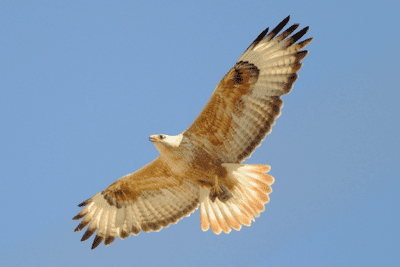
With a breeding range in arid and semi-arid regions in south eastern Europe, you’ll have to travel to Greece or Turkey if you want to see this beautiful European raptor.
Due to habitat destruction, the population of Long-legged Buzzards has declined over past decades, but currently seems to be stable.
The best way to ensure the survival of the Long-legged Buzzards is by protecting or recreating their habitat, which would benefit countless other species as well.
Long legged Buzzard facts
The Long legged Buzzard is a large buzzard with large parts of its underside as well as its tail colored light rufous brown (which explains its latin species name rufinus).
However, similar to many other Buteo species, the Long legged Buzzard has quite variable coloration, and not every individual shows this characteristic rufous coloring.
Long legged Buzzard size
The Long-legged Buzzard is the largest of the buzzards found in Europe, and is considerably larger than the Common Buzzard.
- Wingspan: 116-160 cm
- Length: 50-65 cm
- Weight: 1,100-1,300 g
Due to its large size for a buzzard, the Long-legged Buzzard is called “Adlerbussard” in German, which translates to “Eagle Buzzard”.
In fact, the Long-legged Buzzard is bigger than the Booted Eagle (Aquila pennata), with which it shares part of its range in south eastern Europe and Turkey.
Appearance
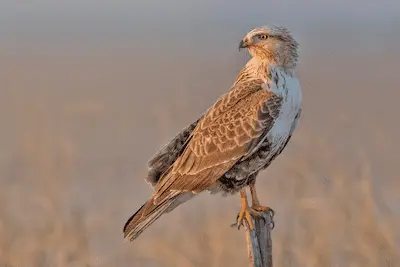
The Long-legged Buzzard is a medium sized European raptor species with long wings and a relatively short tail. Its overall proportions are very similar to other buzzard species, but it is significantly larger than its buzzard relatives, and more on a par with a small eagle species.
Sexual dimorphism
Similar to most European birds of prey, the female Long-legged Buzzards is bigger than its male counterpart. However, this size difference is relatively small, and there is considerable size overlap between the two genders.
Scientific name and taxonomy
The scientific name of the Long legged Buzzard is Buteo rufinus. It is thought that there are two subspecies, only one of which is found in Europe. The closest relatives of the Long legged Buzzard in Europe are the Common Eurasian Buzzard (Buteo buteo), and the Rough-legged Buzzard (Buteo lagopus).
Long-legged Buzzard distribution
The Long-legged Buzzard breeds in a small part of south eastern Europe, with the largest populations in the European part of Russia, as well as Turkey, Greece, and Bulgaria. Outside of Europe, its range extends eastwards to Mongolia and northern India.
Long legged Buzzard habitat
The Long legged Buzzard prefers open arid and semi-arid landscapes, including deserts and steppes. In addition to this it also occurs in hilly country with forests interspersed with open country.
Long-legged Buzzard population size
The entire European population of Long-legged Buzzards is estimated to be between 8,700 and 15,000 breeding pairs. This number includes Turkey, which has the largest population (up to 8,000 pairs). Outside of Turkey, the largest population is in the European part of Russia, which has between 1,000 and 2,000 pairs, followed by Bulgaria (800 pairs) and Greece (300 pairs).
Long legged Buzzard behavior
The Long legged Buzzard is most often seen flying slowly at medium height, while it scans the ground for suitable prey. It also hunts from a perch on power poles and telephone lines. Sometimes the Long legged Buzzard also hovers while hunting, similar to a Rough-legged Buzzard.
Feeding and diet
The most important food source of the Long-legged Buzzard are small rodents, including voles, hamsters, gerbils, and susliks. In addition to rodents it also takes reptiles and young birds.
Breeding
The Long legged Buzzard builds its nest either on trees or on cliffs, and in some cases it also uses old nests made by Ravens. The female lays 2-3 eggs, which are incubated for up to 35 days. After hatching, the chicks stay in the nest for up to 45 days, and continue to be fed for weeks after leaving the nest.
Migration
The Long legged Buzzard is a partial migrant, with most of the individuals from Russia and eastern Europe migrating to northern Africa, where they winter in desert or semi-desert regions. Some individuals from the southernmost part of the European breeding range (including Greece and Turkey) are sedentary.
Long legged Buzzard conservation status
Overall, the European population of Long legged Buzzards appears to be more or less stable, and the conservation status of the Long legged Buzzard has thus been classified as of “Least Concern” by BirdLife International.
Threats
The main threats to the Long legged Buzzard are destruction of habitat through changes in agricultural practices from extensive to intensive cultivation, as well as electrocution on power poles. In addition to these threats, it is also persecuted by illegal shooting on migration.
Additional resources:
- European Honey Buzzard distribution and habitat
- White-tailed Eagle (key facts)
- Osprey feeding and diet